Continental US, Standard shipping: free on orders of $100 or more, $9.99 on orders under $50, and $14.99 from $50 up to $100.
UPS and FedEx options are also offered at checkout, at their own rates.
Orders placed by 11 AM Pacific on a business day ship the same day.
Alaska, Hawaii, US territories, APO/FPO and international addresses: the cost is shown at checkout, and 2-day delivery isn’t available to Alaska, Hawaii or P.O. boxes.
Iron and sulfur fertilizer · 20% Fe · 12% S · ferrous sulfate heptahydrate
About Ferrous Sulfate (Iron Sulfate) 20% Fe
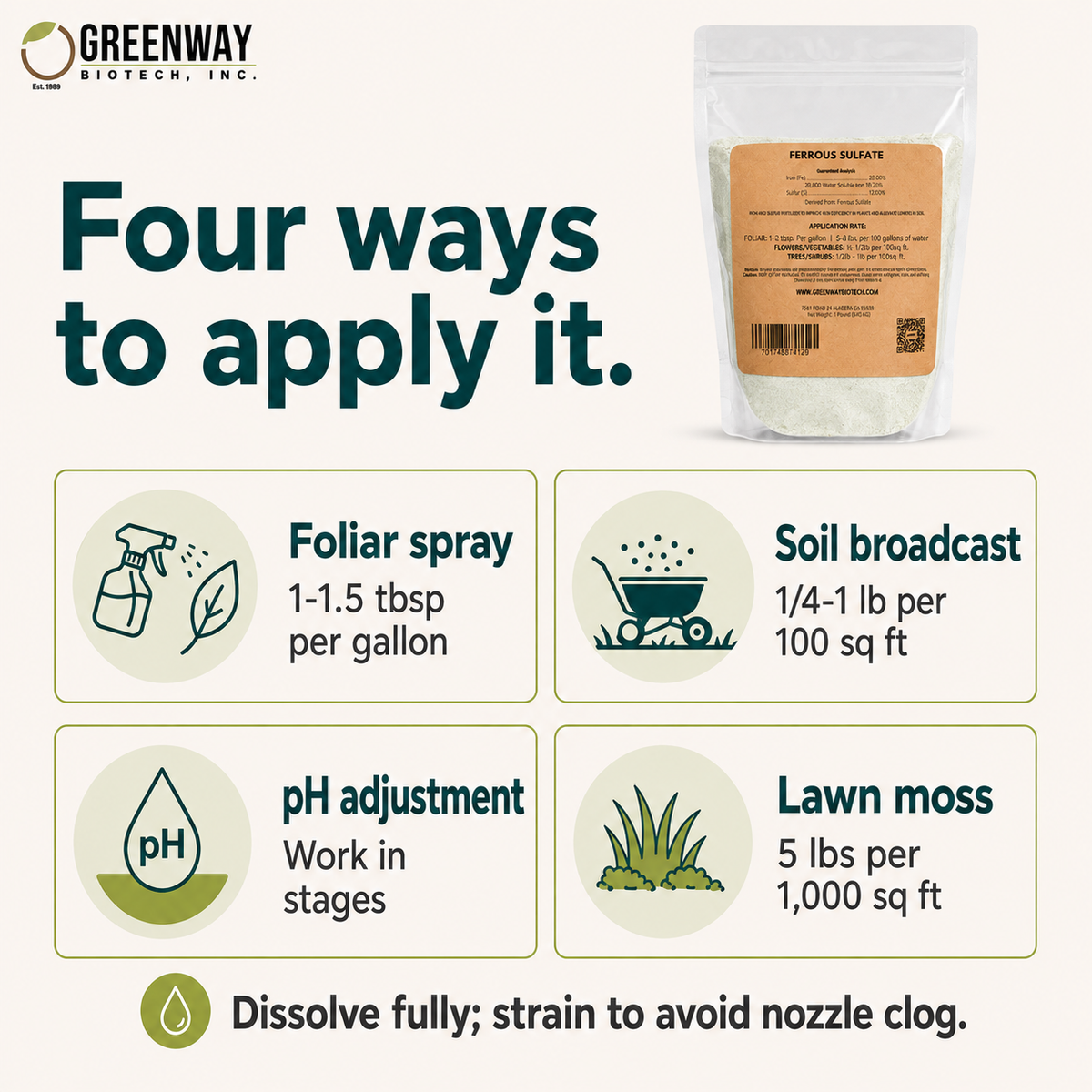
Ferrous sulfate, also called iron sulfate or iron(II) sulfate, is a water-soluble crystal that supplies 20% iron and 12% sulfur. Use it as an economical foliar iron spray for chlorotic plants, as a soil iron source for acid-loving plants in acidic beds, around individual trees by trunk diameter, and as a short-term color boost for lawns. As a raw chemical it is also widely used to knock back moss on lawns and hard surfaces; those directions have their own section below.
Its main limitation is soil pH. Unchelated iron is quickly locked into forms roots cannot use once soil turns neutral or alkaline, so soil applications work best below about pH 6.5, and on alkaline or limey soil the result is spotty and short-lived. Foliar sprays green the leaves they reach at any soil pH, but only for a while. It also stains concrete, stone, and fabric rust-brown. Confirm that the yellowing is iron deficiency, and measure soil pH, before you apply it.
20% Fe · 12% S Guaranteed iron and sulfur (product label), from ferrous sulfate heptahydrate
Below pH 6.5 Where soil-applied iron sulfate stays useful; foliar sprays work at any soil pH, temporarily
1–50 lb bags Seven sizes; the calculator turns your bed, spray, or moss job into an amount and a bag size
Product facts & composition
Guaranteed analysis and product specifications, Greenway Biotech Ferrous Sulfate 20% Fe
Specification
Detail
Iron (Fe)
20% (guaranteed analysis)
Sulfur (S)
12% (guaranteed analysis), present as sulfate
Derived from
Ferrous sulfate heptahydrate (FeSO₄·7H₂O), CAS 7782-63-0. The safety data sheet also lists calcium carbonate as an anti-caking agent.
Iron form
Ferrous iron (Fe²⁺), not chelated
Nitrogen, phosphate, potash
None. This is an iron and sulfur source, not a complete fertilizer.
Physical form
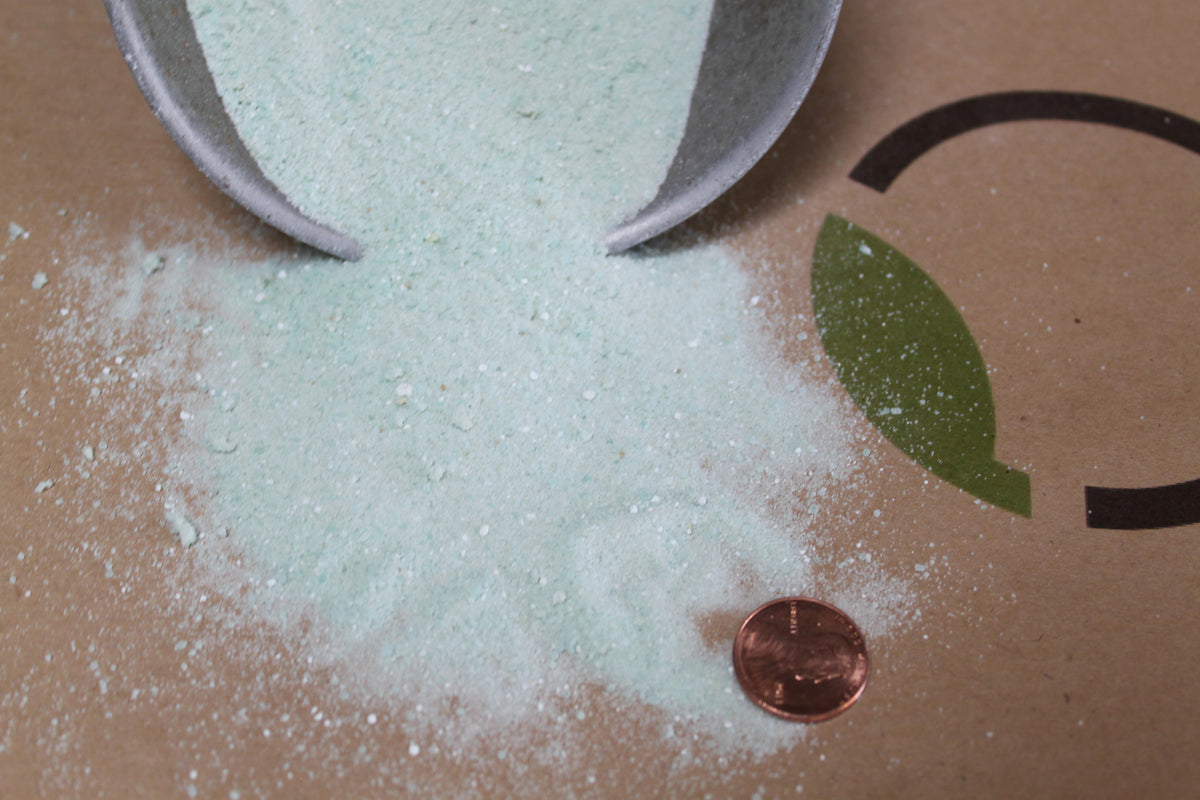
Blue-green to teal crystalline powder or granules (safety data sheet)
Solubility
Freely soluble, about 260 g per liter at 20 °C (68 °F); a 1% solution has a pH between 3 and 4 (safety data sheet). Dissolved ferrous iron gradually oxidizes in air, so mix solutions on the day you use them.
Hazard classification (SDS, March 2026)
Signal word Warning. Causes skin irritation and serious eye irritation; harmful to aquatic life with long-lasting effects.
Registration
CDFA-registered fertilizer. It is not registered with the EPA as a pesticide.
Package sizes
1, 2, 3, 5, 10, 25, and 50 lb (the 50 lb size may ship as two 25 lb bags)
Packed by
Greenway Biotech, Inc., Madera, California
Percentages are by weight of product: 1 lb of product contains 0.20 lb (3.2 oz, 91 g) of iron and 0.12 lb (1.9 oz, 54 g) of sulfur, and a 25 lb bag contains 5 lb of iron and 3 lb of sulfur. Every rate on this page is product weight unless it says otherwise.
Best uses & benefits
Choose ferrous sulfate when the diagnosis and the soil pH both fit. Yellow leaves have many causes, and iron sulfate solves only one of them; eight common causes of yellow leaves are worth ruling out first.
A quick foliar iron spray
Utah State and Oregon State Extension both use a 0.5% iron sulfate spray for iron-chlorotic trees, shrubs, and acid-loving plants. Because the spray goes on the leaf, it works whatever the soil pH; Colorado State notes that the response can come within days but is often spotty and temporary.
Iron and sulfur for acid-loving plants
Blueberries, azaleas, rhododendrons, camellias, and gardenias in beds that already test acidic. The 12% sulfur arrives as plant-available sulfate, and the iron’s oxidation in soil adds a quick local acidifying effect alongside the elemental sulfur that does the long-term pH work.
Individual trees, measured by trunk diameter
Kansas State Extension gives a weighed rate per inch of trunk diameter, spread under the canopy or placed in holes, with a 1:1 mix of iron sulfate and elemental sulfur as the alternative where iron alone is fixed too quickly. Utah State reports that such a treatment may last 2 to 4 years.
Short-term lawn color
University of Florida IFAS research found that iron sulfate works on turf only as a liquid on the leaves, where it generally improves color for up to 4 weeks without the growth surge that nitrogen brings.
Moss on lawns and hard surfaces
A common use of the raw chemical: iron at high concentration blackens moss. It is a temporary knockdown. Extension services agree that moss returns unless shade, drainage, compaction, fertility, and pH are corrected. Moss directions
Where it is a poor fit
Soil applications on alkaline or calcareous soil. Colorado State Extension calls soil applications of iron alone ineffective in alkaline soil, where iron is rapidly fixed above pH 7.0. Use Chelated Iron DTPA to about pH 7.5, and an Fe-EDDHA chelate above that.
Yellowing that has not been diagnosed. Iron deficiency starts on the youngest leaves. Yellowing that starts on older leaves points to nitrogen, magnesium, or another mobile nutrient, and soggy, compacted, or damaged roots cause the same symptom.
Hydroponic and recirculating systems. Unchelated iron drops out of aerated solutions within minutes at pH 7.0 or higher and can clog emitters. Use a chelate.
A planned pH change. It takes about 8 lb of ferrous sulfate to do the acidifying work of 1 lb of elemental sulfur (Michigan State University Extension). Use Elemental Sulfur Powder for that job.
Roofs, painted, or light-colored surfaces. Iron stains them rust-brown, and roof runoff carries the iron into gutters and storm drains.
A complete fertilizer. It supplies iron and sulfur only.
Application rates & directions
Every rate below is product weight and names its source: Greenway’s own directions, or the university Extension publication listed in section 13. Fertilizer uses come first; moss control, a non-fertilizer use of the raw chemical, has its own subsection, and its rates are never used for feeding plants. Confirm iron deficiency on the youngest leaves and measure soil pH before applying any of these.
Weigh it. The density of this product has not been measured, so no gram figure is given for spoon or cup measures. Use a kitchen scale for beds, sprays, and moss jobs, and a bathroom or hanging scale for trees and lawns.
Soil: acidic beds and acid-loving plants
Greenway soil rates for beds that test below about pH 6.5, product weight per 100 sq ft, one application per confirmed need
Planting
Rate per 100 sq ft
Iron delivered
Method
Flowers and vegetables
¼–½ lb (113–227 g)
23–45 g Fe
Spread evenly over the measured bed, keep it off foliage, and water in thoroughly
Shrubs
½–1 lb (227–454 g)
45–91 g Fe
Spread under the drip line, keep it off the stems, and water in
As for shrubs; correct the bed’s pH with elemental sulfur, not with more iron sulfate
Source: Greenway directions for this product. Start at the low end, apply once, and judge the result on new growth over the following weeks before treating again. These rates assume soil already below about pH 6.5; Oregon State Extension puts the target for azaleas, blueberries, and rhododendrons at 4.5–5.5. On neutral or alkaline soil, soil-applied iron sulfate is fixed quickly and gives a spotty, short-lived result, so use a foliar spray as a bridge and a chelate matched to the pH. Sweep any granules off paths and patios before watering: wet iron sulfate leaves reddish-brown stains that are difficult to remove.
Individual trees: the per-inch directions
Iron sulfate soil treatments for an individual tree, from Kansas State University Extension MF718, product weight per inch of trunk diameter
Situation
Rate
Placement and timing
Ferrous sulfate alone, on soil that is not alkaline
1 lb per inch of trunk diameter (454 g per inch; 91 g of iron)
Bare soil: spread evenly under the canopy to beyond the drip line, worked in with core cultivation if you like. Turf-covered soil: divide the amount equally among holes 6–10 inches deep and 2 feet apart in a grid, starting 2–3 feet from the trunk and extending past the drip line, about 4–5 holes per inch of diameter. Early spring, as buds begin to swell.
1:1 mix of ferrous sulfate and elemental sulfur, for alkaline soil without free lime
1 lb of mix per inch for trees 4 inches or smaller; 2–3 lb of mix per inch for larger trees
Applied the same way, in early spring
Measure the trunk’s circumference 4 feet above the ground and divide by 3.14 to get its diameter. Worked example: a tree 25 inches around is 8 inches in diameter; on non-alkaline soil that is 8 lb of ferrous sulfate; with the sulfur mix it is 16–24 lb of mix, half of it ferrous sulfate (8–12 lb). Kansas State reports that the hole treatment remains effective for 2 to 3 years, and Utah State that an iron sulfate and sulfur treatment may last 2 to 4 years, though it is not practical or desirable to blanket a whole landscape with it. Colorado State finds iron alone ineffective in alkaline soil and limits the iron sulfate and sulfur approach to soils without free lime: if your soil fizzes when vinegar is poured on it, use a chelate instead.
Foliar spray for iron chlorosis
Foliar iron sulfate sprays, product per volume of water
Source
Mix
Per gallon
Utah State Extension; Oregon State Extension EC 1560
2 oz of ferrous sulfate in 3 gal of water (a 0.5% solution)
About 0.67 oz (19 g)
Kansas State Extension MF718 (trees)
5 lb in 100 gal of water
About 0.8 oz (23 g)
Greenway household measure
1–1½ tablespoons per gallon of water; start at 1 tablespoon
Volume only; not converted to grams
Spray in the evening or on a cool, cloudy day to avoid leaf burn (Utah State), and wet the yellow leaves thoroughly; Kansas State notes that a little detergent helps the spray stick. Colorado State warns that the margin between a concentration that greens leaves and one that burns them is small, and burned leaf tissue turns black, so spray a few leaves and wait a day or two before treating the whole plant. A spray treats only the leaves it reaches, and new growth can come out yellow again. Repeat only when new leaves show symptoms; Oregon State, for acid-loving plants waiting on soil acidification, repeats it every other week during the growing season. Keep drift off siding, fences, and paving, where it leaves a permanent rusty stain.
Lawn color
University of Florida IFAS (EP551) recommends iron sulfate on turf only as a liquid sprayed on the grass blades, at 1–5 lb of iron per acre: that is about 1.8–9.2 oz (52–260 g) of this product per 1,000 sq ft, dissolved in enough water to cover the area evenly. Leave it on the leaves rather than watering it in; the same research measured as much as 95% of applied iron becoming unavailable within an hour of soil contact. Expect better color for up to 4 weeks, and note that some lawns do not respond. Going above that rate increases the chance of leaf burn and can turn the grass temporarily black. This is Florida research; start at the low end elsewhere.
Lowering soil pH
Ferrous sulfate acidifies soil faster than elemental sulfur because it does not wait for soil bacteria, but it takes far more of it. Michigan State University Extension’s conversion is 8 lb of ferrous sulfate for each 1 lb of elemental sulfur in a sulfur rate table, so a meaningful pH change takes amendment-scale amounts and a heavy load of iron and salt. For a planned pH change, test the soil and use Elemental Sulfur Powder at a soil-test rate; Oregon State advises acidifying gradually and allowing several months, and up to a year, for the reaction. Colorado State says lowering pH is impractical to impossible on soil that contains free lime. Use ferrous sulfate for its iron, with acidification as a local bonus in beds and tree holes. More background: why soil pH plays a bigger role than you might think.
Hydroponic and nutrient solutions
Do not use ferrous sulfate in a hydroponic reservoir or a recirculating system. University of Florida IFAS reports that unchelated iron stays soluble for no more than a few minutes in aerated solutions at pH 7.0 or higher; at reservoir pH it oxidizes, drops out, and can clog emitters and filters. Use Chelated Iron EDTA where the solution is held at pH 5 to 6, or Chelated Iron DTPA where it drifts above 6.5.
Moss on lawns and hard surfaces (a non-fertilizer use)
Greenway sells this product as a fertilizer. Moss control is a common use of ferrous sulfate as a raw chemical, and the directions below describe that use; they are not pesticide label directions, and they are not fertilizer rates. Extension guidance treats iron as a short-term knockdown while you fix the conditions that let moss beat the grass.
Ferrous sulfate for moss, product weight per area or per gallon, with the source of each rate
Job
Rate
Method
Source
Lawn moss, dry
5 lb per 1,000 sq ft (1 lb of iron)
Broadcast evenly over the moss with a spreader while the moss is actively growing, then water in lightly
Greenway rate; within the 0.5–1.5 lb of iron per 1,000 sq ft that University of Alaska Fairbanks Extension gives for iron moss products
Lawn moss, liquid
5 lb per 1,000 sq ft, dissolved
Dissolve in at least 3 gal of water per 1,000 sq ft (more in cold water) and spray evenly
Greenway rate; same iron as the dry rate
Lawn moss, light spray
3–5 oz in 4 gal of water per 1,000 sq ft, or 4–7 oz in 3–5 gal
Spray the moss evenly; far less iron, a gentler start for lawns that are mostly grass
NC State Extension; University of Georgia Extension C 823
Walks, patios, and walls where a rust stain is acceptable
3 oz per gallon of water
Spray the moss, let it work, then remove the dead moss with a stiff brush
Greenway rate; no Extension rate found for iron on hard surfaces
Stains and safety. Iron stains concrete, stone, brick, pavers, painted surfaces, siding, and clothing rust-brown, and rinsing does not reliably prevent it. Sweep granules off paving before watering, and do not spray surfaces you want to keep unmarked. Do not use it on roofs: it stains roofing and trim, and runoff carries it into gutters and storm drains. The product irritates skin and eyes, so wear gloves and safety glasses. Keep children and pets off the treated area until the granules are watered in and the surface is dry, and keep runoff out of storm drains, ponds, and streams.
What to expect. Iron turns moss black (Penn State Extension), and the dead moss still has to be raked or brushed out (Oregon State). At the 5 lb rate the grass may darken for a while too (University of Florida IFAS), because that rate puts down roughly nine times the iron of the heaviest lawn-color spray; start with the light spray if the lawn is mostly grass. Then overseed thin spots after a few weeks (University of Alaska Fairbanks). Moss returns unless the conditions change: Oregon State, UConn, NC State, Georgia, and Kansas State all make that point. Washington State and Penn State list the conditions to fix: shade, poor drainage, compaction, low fertility, and acid soil. Prune for light, aerate, improve drainage, feed the grass on its normal schedule, and use shade-tolerant grasses where needed. Iron sulfate itself can lower soil pH over time, so test the soil and lime only if the test calls for it (Oregon State).
How to use ferrous sulfate
Check the need. Iron deficiency shows as yellow tissue between green veins on the youngest leaves first. Check drainage and roots, then measure soil pH: below about 6.5 a soil application can work; above it, plan on a foliar spray as a bridge and a chelate matched to the pH. For moss, look at shade, drainage, and compaction before you treat.
Pick the use and the rate. Use the row in section 4 that matches your job: beds per 100 sq ft, trees per inch of trunk diameter, sprays per gallon, lawn color or moss per 1,000 sq ft. Do not swap rates between uses; moss rates are far heavier than feeding rates.
Measure, then weigh. Measure the area, trunk diameter, or spray volume, and weigh the product on a scale. For a spray, dissolve it fully in water and mix only what you will use that day.
Apply and protect the hardscape. Spread beds and tree areas evenly and water in; spray leaves in the evening or on a cool, cloudy day; broadcast moss rates while the moss is actively growing. Sweep granules and rinse drift off paving at once, wear gloves and safety glasses, and keep children and pets off until it is watered in and dry.
Watch, then decide. Judge an iron treatment on the new leaves over the following weeks, and retest pH before another soil application. Rake out blackened moss, overseed, and fix the conditions that let it in.
Calculator & choosing a size
Formulas. Beds: product (lb) = square feet ÷ 100 × rate (¼–½ lb for flowers and vegetables, ½–1 lb for shrubs and acid-loving plants). Trees: product (lb) = trunk diameter in inches × 1 for ferrous sulfate alone, or × 1 (trees up to 4 inches) or 2–3 (larger trees) for the 1:1 mix with sulfur, half of which is ferrous sulfate. Foliar spray: product (oz) = gallons × 2 ÷ 3, about 19 g per gallon. Lawn color: product (oz) = square feet ÷ 1,000 × 1.8 to 9.2. Lawn moss: product (lb) = square feet ÷ 1,000 × 5, or ounces = square feet ÷ 1,000 × 3 to 7 for the light spray. Hard surfaces: product (oz) = gallons × 3. Multiply pounds by 453.6 for grams.
Worked examples. A 150 sq ft azalea bed at pH 6.0: 1.5 × ½–1 lb = 0.75–1.5 lb; start at 0.75 lb, and a 1 lb bag covers it. An 8-inch tree on bare, non-alkaline soil: 8 lb; a 10 lb bag. A 2 gal foliar spray: 1.33 oz (38 g); a 1 lb bag makes 24 gal. Lawn color on 5,000 sq ft at the low end: 9.2 oz (260 g); a 1 lb bag. Moss on a 3,000 sq ft lawn at 5 lb per 1,000 sq ft: 15 lb, which takes a 25 lb bag or a 10 lb and a 5 lb bag; the light spray on the same lawn takes 9–21 oz, a 1 lb or 2 lb bag. A 4 gal hard-surface spray: 12 oz; a 1 lb bag.
What each bag covers at the rates on this page
Bag
Lawn moss at 5 lb per 1,000 sq ft
Acid-loving bed at ½ lb per 100 sq ft
Foliar spray at 2 oz per 3 gal
Trees at 1 lb per inch
1 lb
200 sq ft
200 sq ft
24 gal
1 inch of trunk
2 lb
400 sq ft
400 sq ft
48 gal
2 inches
3 lb
600 sq ft
600 sq ft
72 gal
3 inches
5 lb
1,000 sq ft
1,000 sq ft
120 gal
5 inches
10 lb
2,000 sq ft
2,000 sq ft
240 gal
10 inches
25 lb
5,000 sq ft
5,000 sq ft
600 gal
25 inches
50 lb
10,000 sq ft
10,000 sq ft
1,200 gal
50 inches
About the calculator. Choose the job: acidic beds, a tree by trunk size, a foliar spray, lawn color, lowering soil pH from a soil test, or one of the moss jobs. It applies the weighed rate from section 4 for that job, starting at the low end of a range, and shows the iron supplied and, for sprays, the water to mix it in. It works in weights only; the tablespoon measure above is not converted. Bed and tree amounts appear only when the soil pH suits iron sulfate, and the pH option multiplies your soil test’s elemental sulfur rate by Michigan State’s factor of 8. Bag suggestions use the current price and stock of all seven sizes, 1 to 50 lb, and the 50 lb size counts as 50 lb. Tax and shipping are added at checkout.
The calculator needs JavaScript. If it does not appear, use the formulas, examples, and table above to choose a size.
How ferrous sulfate works
Iron is needed for chlorophyll and for the enzymes of photosynthesis and respiration, and it barely moves once it is in a leaf, so a shortage shows first as yellow tissue between green veins on the newest growth. Most soils hold plenty of iron; the problem is solubility. University of Florida IFAS notes that ferrous iron is readily oxidized to the ferric form plants cannot use once soil pH is above about 5.3, and that iron deficiency often appears above pH 7.4. Ferrous sulfate dissolves into ferrous iron and sulfate, so the iron is usable the moment it dissolves, and it starts reacting with the soil just as fast. That is why soil applications hold up in acidic beds and fade on neutral and alkaline soil, and why a foliar spray works at any soil pH but greens only the leaves it reaches.
In soil, the ferrous iron oxidizes and forms iron hydroxide, releasing acid as it goes (4FeSO₄ + O₂ + 10H₂O → 4Fe(OH)₃ + 4H₂SO₄). The effect is fast and local, but small per pound: Michigan State University Extension counts 8 lb of ferrous sulfate for each pound of elemental sulfur. Free lime neutralizes the acid, which is why Colorado State calls pH reduction on limey soil impractical. The sulfate itself is the form of sulfur plants take up, so the 12% sulfur is available without the bacterial step that elemental sulfur needs.
At the much higher concentrations used on moss, iron acts as a contact burn: University of Alaska Fairbanks Extension describes iron compounds as contact herbicides for lawn moss. Lawn moss treatments rely on grass tolerating a dose that blackens moss, but the margin is limited; University of Florida IFAS reports that iron above lawn-color rates can turn grass temporarily black. The evidence on this page concerns ferrous sulfate as an ingredient; it is not a trial of this finished product.
Compare your options
For iron, the measured pH of the soil or solution decides which product works. Chelate stability figures are from University of Florida IFAS HS1208; analyses are each product’s label guarantee.
Ferrous Sulfate 20% Fe compared with other ways to supply iron or lower pH
Option
Supplies
Choose it when
Limitation
Ferrous Sulfate 20% Fe, this product
20% Fe, unchelated; 12% S
Soil below about pH 6.5, foliar sprays at any soil pH, single trees by diameter, lawn color, moss
Fixed quickly in neutral and alkaline soil; not for reservoirs; stains
Add a companion only when the soil test or diagnosis shows the need; none is required with ferrous sulfate.
Elemental Sulfur Powder: the tool for lowering soil pH, and the other half of the 1:1 tree-hole mix.
Chelated Iron DTPA 11% Fe: soil iron for neutral to moderately alkaline ground, where iron sulfate is fixed too quickly.
Ammonium Sulfate 21-0-0: an acidifying nitrogen source for lawns recovering from moss and for acid-loving plants.
Chelated Manganese EDTA: for yellowing that a tissue test attributes to manganese rather than iron; the two look alike.
Same program is not the same tank. In a concentrated solution, ferrous sulfate forms precipitates with phosphate fertilizers, calcium fertilizers, lime, wood ash, and alkaline water, and the safety data sheet lists alkaline materials and strong oxidizers as incompatible. Dissolve each product separately, combine only in a dilute solution, jar-test any new mix, and follow every product’s own directions; a clear jar does not prove crop safety. Use plastic, not iron or steel, buckets and tanks.
Handling, storage & limitations
Classification (SDS, March 2026). Warning: causes skin irritation and serious eye irritation; harmful to aquatic life with long-lasting effects. Wash thoroughly after handling and avoid release to the environment.
Protective equipment. Safety glasses with side shields, plus a face shield when mixing or spraying; nitrile or rubber gloves; an N95 or other respirator when dust is not controlled. Wear old clothing: iron leaves permanent rust stains on fabric.
Staining. Keep granules and spray off concrete, stone, brick, pavers, wood decks, siding, and painted surfaces. Sweep granules up dry, before watering, and rinse drift at once; stains that set are difficult to remove.
Storage. Cool, dry place out of direct sun, in the sealed original bag; the product absorbs moisture and cakes. Not in iron or steel containers. Away from strong oxidizers and alkaline materials such as lime and wood ash. Out of reach of children and pets. Crystals that turn yellow-brown have begun to oxidize.
Children, pets, and water. Keep children and pets off treated areas until the product is watered in and the surface is dry. Pet Poison Helpline lists iron among the fertilizer ingredients that can poison a pet that eats a larger amount. Do not let product or rinse water reach storm drains, ponds, or streams.
Application limits. One soil application per confirmed need, then reassess. Test foliar sprays on a few leaves first. Not for hydroponic reservoirs, roofs, or soil with free lime.
First aid (from the safety data sheet). Eyes: rinse cautiously with water for 15 minutes, removing contact lenses if easy; get medical advice if irritation persists. Skin: remove contaminated clothing and wash with plenty of soap and water. Inhaled: move to fresh air and rest. Swallowed: rinse the mouth; do not induce vomiting; get medical advice. Poison Control: 1-800-222-1222.
Disposal. Do not let product drain into sewers or waterways; dispose of it according to local, state, and federal rules.
California Proposition 65 warning (from the safety data sheet): this product can expose you to chemicals including arsenic, cadmium, and lead, which are known to the State of California to cause cancer and reproductive harm. For more information go to www.P65Warnings.ca.gov.
The full handling and first-aid directions are in the Safety Data Sheet.
Frequently asked questions
What is ferrous sulfate, and when should I choose it over chelated iron?
Ferrous sulfate, also called iron sulfate, is a water-soluble crystal supplying 20% iron and 12% sulfur. Choose it for foliar iron sprays, for acid-loving plants in beds that test below about pH 6.5, for individual trees by trunk diameter, and for lawn color. Above about pH 6.5 in the soil, choose a chelate: Chelated Iron EDTA holds iron to about pH 6.5, Chelated Iron DTPA to about pH 7.5, and an Fe-EDDHA product above that.
Will ferrous sulfate fix yellow leaves on alkaline soil?
Not through the soil. Colorado State Extension says iron applied alone to alkaline soil is quickly converted to forms roots cannot use, so the result is spotty and short-lived. A foliar spray will green the sprayed leaves at any soil pH, but new growth can come out yellow again. For lasting correction on alkaline soil, use Chelated Iron DTPA up to about pH 7.5, or an Fe-EDDHA chelate above that. For a single tree on alkaline soil without free lime, Kansas State and Utah State describe a 1:1 mix of ferrous sulfate and elemental sulfur placed in holes.
How do I mix a foliar iron spray?
Dissolve 2 oz of ferrous sulfate in 3 gal of water, about 19 g per gallon, the 0.5% spray used by Utah State and Oregon State Extension. Greenway’s household measure is 1 to 1½ tablespoons per gallon, starting at 1. Spray in the evening or on a cool, cloudy day, wet the yellow leaves thoroughly, and test a few leaves first, because burned leaf tissue turns black. Mix only what you will use that day, and repeat only when new leaves show symptoms.
How much should I use around a tree?
Kansas State Extension gives 1 lb per inch of trunk diameter, measured 4 feet above the ground, in early spring as buds swell: spread under the canopy to beyond the drip line on bare soil, or divided among holes 6 to 10 inches deep and 2 feet apart on turf-covered soil. Its alternative is a 1:1 mix with elemental sulfur, 1 lb of mix per inch for trees up to 4 inches and 2 to 3 lb per inch for larger trees. On alkaline soil, use the sulfur mix, which works only where the soil has no free lime; if the soil fizzes with vinegar, use a chelate instead.
How much ferrous sulfate do I use for moss in a lawn?
Greenway’s rate is 5 lb per 1,000 sq ft, broadcast dry and watered in lightly, or dissolved in at least 3 gal of water and sprayed. That is 1 lb of iron per 1,000 sq ft, within the range University of Alaska Fairbanks Extension gives for iron moss products. NC State and University of Georgia Extension use a lighter spray of 3 to 7 oz in 3 to 5 gal of water per 1,000 sq ft, which puts down far less iron. Moss turns black and must be raked out, the grass may darken for a while, and moss returns unless shade, drainage, compaction, fertility, and pH are fixed.
Can I use it on moss on walkways, patios, or roofs?
On walks, patios, and walls where a rust stain is acceptable, spray 3 oz per gallon of water on the moss, then brush the dead moss off. Expect the surface to stain rust-brown; rinsing does not reliably prevent it. Do not use it on roofs, painted surfaces, siding, or light-colored stone, and keep runoff out of gutters, storm drains, and ponds. Oregon State Extension’s roof guidance relies on cleaning, trimming shade, and products made for roofs, not on iron.
Will ferrous sulfate stain concrete or clothing?
Yes. Iron leaves reddish-brown stains on concrete, stone, brick, pavers, painted surfaces, and fabric, and University of Florida IFAS notes that the stains are difficult to remove because they form chemically. Sweep granules off paving before watering, rinse spray drift at once, keep spray off siding and fences, and wear old clothes.
Is ferrous sulfate safe around children and pets?
Treat it with care. The safety data sheet classifies it as a skin and eye irritant and says to keep it out of reach of children and pets, and Pet Poison Helpline lists iron among the fertilizer ingredients that can poison a pet that eats a larger amount. Keep children and pets off treated areas until the product is watered in and the surface is dry, store the bag sealed and out of reach, and keep runoff away from ponds and streams, because it is harmful to aquatic life.
Can I use ferrous sulfate to lower soil pH?
It acidifies quickly, but it is an expensive and heavy way to do it: Michigan State University Extension counts 8 lb of ferrous sulfate for each pound of elemental sulfur. For a planned pH change, test the soil and use elemental sulfur, allowing months for it to work. On soil that contains free lime, Colorado State says lowering pH is impractical. Use ferrous sulfate for its iron, with its acidifying effect as a local bonus.
Can I use it in hydroponics or mix it with other fertilizers?
Not in hydroponics: unchelated iron drops out of aerated solutions within minutes at pH 7.0 or higher and can clog emitters, so use Chelated Iron EDTA or DTPA instead. In concentrated mixes it forms precipitates with phosphate and calcium fertilizers, lime, wood ash, and alkaline water. Dissolve each product separately, combine only in a dilute solution, jar-test new mixes, and use plastic rather than steel containers.
Articles give background. For this product, use the directions and documents on this page.
Product documents & sources
Product label (PDF): the registered label with the guaranteed analysis. It predates this page’s rate review; if your bag prints different directions, ask us before applying.
Safety Data Sheet (PDF, March 2026): composition, hazard classification, handling, storage, first aid, disposal, and the California Proposition 65 statement.
Heavy-metal test results: available on request. Email questions@greenwaybiotech.com with the product name and we will send the current document.
Where the rates and statements on this page come from
The bed, household foliar, and moss rates marked as Greenway rates are Greenway’s own directions for this product; the tree, foliar, lawn, pH, moss, and diagnosis statements credited to universities come from the Extension publications below, which explain nutrient and moss management and do not certify or endorse this product.
Not sure whether the yellowing is iron, or whether your soil pH suits iron sulfate or a chelate? Email your plant, soil pH, area or trunk diameter, and what you have tried to questions@greenwaybiotech.com or call (562) 351-5168, Monday to Friday, 9 AM to 3 PM Pacific, and we will work through it with you. Every order carries a 90-day satisfaction guarantee, and Standard shipping is free on orders over $100 to the continental US.
Greenway Biotech, Inc. has been a family-owned fertilizer company in California since 1989. This product is packed at our facility in Madera, California, and is a CDFA-registered fertilizer.
5 stars: 44 (81%)
4 stars: 3 (6%)
3 stars: 3 (6%)
2 stars: 0 (0%)
1 star: 4 (7%)
b
brian west
Still waiting on delivery! Tracking shows all over the country
Still waiting on delivery! Tracking shows all over the country, including being in Buffalo.
J
Judy Fick
Missing a bag
Ordered 4 bags of iron only received 3. Emailed the company. They responded after 3 business days. Said they would complete my order by shipping out a new bag. But as of yet no 25 pound bag of iron and no tracking number and no money. This stuff isn’t cheap and the time to fertilize is quickly closing. It is a good product but no really fast or quality customer service. 😞
R
Rick Platt
Product is great. Shipping Package was leaking Product when it arrived.
L
Louise Prister
Thank you guys.
W
Wayne Ristine
Poor customer service
Ordered 2 only received 1. They don’t answer phone or email. Poor customer service.
B
Brian Hayes
Excellent product
Better than Amazon. Will buy from again!!
P
Patricia Cravener
Thank you!
I use Iron Sulfate to make alkaline soil more acidic. I thank you for it. The magnolia tree and a few hydrangeas benefit. When I run out, I order more of it. Thank you for making your products available to backyard gardeners.
B
Bob Lee
Gardenias love Ferrous sulfate
I’ve been using Greenway Biotech’s product on my gardenias for five or six years now and they always look fantastic, no yellowing whatsoever. Once a month does the trick.
W
Wayne Ristine
good product
fast shipping, reasonable price and will buy again
B
Bob Lee
Long time patron
I have been using Greenway biotech Ferris sulfate for 10 picture up to Alvin Bragg, and
I have been using Greenway Biotech ferrous sulfate for 10+ years now. It has been a blessing especially for my gardenias as well as other plants.
P
Patricia Cravener
outstanding in all respects
I've been buying Greenway Biotech FeSO4 for years, to improve the soil around plants that do best in acidic soil: a magnolia, a couple of potted dwarf blueberries, some hydrangeas . . . I count on the company for excellent products. This was the first time I've ordered directly from Greenway Biotech, instead of using Amazon. Absolutely amazing! Locating and ordering from their Website could not be simpler. The single-item order was confirmed within minutes. Shipping was confirmed about four hours later. The company even tracks orders for customers! Overall, a perfect no-flaws retail experience. I've been thinking about what other products I buy once a year or so, here and there, and am making a list of the things Greenway Biotech offers so that I can order from that company, all at once, in the future.
T
Terrence Smith
Out the moss!
This is a great product for controlling moss in a lawn. I've tried a lot. I just mix with water in my sprayer and wet it down. You can adjust the amount of product you mix according to moss problem?
M
Macey White
good product with fast delivery
good product with fast delivery
J
Judith Naftulin
Ixora on rebound
Seems to be slowly reviving my yellowed Ixora here in Florida. Love that product did not come from Amazon but rather a more personalized business. Would buy again for sure!
A
Andy Chambley
Kills the shit out of moss overnight!
Really super fast
J
Judith Brown
Thank you!
Happy I had a fresh bag because my old bag of ferrous sulfate was not working properly anymore in the indigo iron vat. The fresh bag worked great.
I
Ileana Perez
Good Experience
Thanks for the fast delivery!
P
Peter Barker
Awesomely fresh product and quick delivery!
Fresh green product that worked for me. I was very pleased to get the delivery so quickly, and right when I needed it.
V
Vladimir Kariaka
Great!
I used for plants. I can't see any visible changes. Still looking.
G
Gregory Burns
Ferrous sulfate purchase
It worked very well to kill moss in lawn.
J
Jonathan Derryberry
Will buy again!
Fast and free shipping. Well packaged.
J
James Kelly
Product worked wonderful and quickly to green up the leaves. on all our fruit and redwood trees.
P
Pete Kamer
Great service
Good 👍👍👍👍👍👍👍👍👍👍👍👍👍👍
W
Winona quigley
Great product that arrives on time!
I use this for commercial scale dye production and Greenway always has my back.
R
Richard G Allard
Works great !
D
Dr.&Mrs. R.Thomas Plunkett
Horrible customer service after your shipping mistake my order was canceled after one week of wai...
Never got the chance to use your product as you unfairly retracted my order.
A
Ann Galloway Nay
Chlorotic Azelia treatment
The product worked well with a chlorotic azelia that has been struggling for more than a year in Indiana clay soil. It is so good to see it green and thriving again.
c
christine cattier
Ferrous Sulfate
Very good experience and this is not the first time I purchase these products from Greenway Biotech
W
William Argeros
Nice product but underestimated coverage
When used according to directions it appeared to have an almost immediate effect on the moss, but a week later it was still thriving. I increased the dosage by about 25% and reapplied it. It seems to have done the trick.
E
Edna Brooks
Moss relief
Think this is working well. I applied it a little late in season as grass is beginning to cover the moss -- but definitely shows results in some areas. Also, I applied to a large area using a watering can -- so may not be perfect way to apply -- but
I'm pretty sure it has cut down on the way moss had begun to take over in my lawn.
L
Len Hutchison
Too soon to tell
Very ease to use, but too soon to tell if the product suits the needs of my azalais. Shipment and delivery very good.
K
Karen Harrell
Cure iron chlorosis
Our lawn had patches of yellow in late spring which we determined was iron chlorosis. Just a few days after sprinkling the ferrous sulfate on those areas, the grass was turning green again.
My MSM is decreasing my osteoarthritis pain, especially in my hands
My product arrived intact. I started taking it as soon as I went into the kitchen. I mixed it with my daily Metamucil, but there was no discernible taste. I am working on making it a habit each morning. The pain from my osteoarthritis, especially in my hands, is decreasing. I expect it to continue to improve. Thank you for my MSM.
You did not send me MSM Powder, you sent me Magnesium Chloride powder. I tried contacting you 3 times, by email & phone and you didn't have the courage & honesty to return my messages & rectify the situation. I even offered to text you a photo of the mag chloride.